
During our reviews on friday we discussed my project and its direction, and it seems like I'm basically on the right track. I think the two major concerns were the narrative that I want to explore as well as the sameness of the pods I was making.
Patrick suggested that I could make them in any shape I wanted really, and I think that makes a lot of sense. They don't necessarily need to be squares or cubes, and they certainly don't need to look the same all over. If my idea is that I want this building to react intelligently, then I'll need to let each pod play itself out in a smart way, and then work on making them breathe, heat, and do whatever else I need them to do.
My narrative came into question as well, but I kind of expected that, since I was really unsure of what I wanted to do with it. I knew that I wasn't building this for homeless people anymore, even though I had done some research on that. If this is going to work, the pods need to be inhabited by technologically savvy hackers so that the building can be wired and tinkered with during its operation.
I think my real question is who are these people? How many of them are there? Why are they living on the side of a building? These are all questions that I really want to consider and have a solid idea about, because when I start building, some of that character needs to come out in their pods.
I have a lot to think about now, but I think I'm on the proper track, there's just a lot of work ahead of me.
3.09.2008

Connections
During the laser cutter's hiatus, I had to look for something else to do other than my model. This was tougher than it seems, but I did manage to get a bit of thinking done about what I want my building to be and how I can accomplish it. I decided that I wanted to have small pods on the outside of the building that could hook into the existing facade for support. This was actually a pretty tough thing to do, since I have no spot to actually cling to, and I have to come up with a way of securely fastening the pod structures to the exterior of the building.
This was my initial design for the platform connection.

I think it should work out pretty well, and it could be built rather easily. The second thing that I looked at was a system of cooling the building. I already know of a few good ways to passively heat the building, but cooling is another issue entirely. I felt like I wanted to do something pretty drastic, like have the building actually react in a physical way to the changes in its environment. Instead of just activating a fan or something like that, I could actually change how the building looks.
To do this, I came up with the idea of the "breathing" pod structure. Basically, two of the walls were on some kind of mechanical connection, when the pod was too hot, it could shoot two of the walls outward and let fresher, cooler air in, and promote air movement inside. This would cool the pod, and hopefully its occupant(s).
Here is a REALLY quick drawing of what I think my structure might look like towards the end of the project. This is quite rough, and was more of an exploration than a careful drawing, but I started to notice that some of the pods could use tension to be hung off the building, while others could rest on cornices and use compression to stand up, while still others could use a hybrid system. It's all pretty preliminary still, but I think I like the direction this is taking.
This was my initial design for the platform connection.

I think it should work out pretty well, and it could be built rather easily. The second thing that I looked at was a system of cooling the building. I already know of a few good ways to passively heat the building, but cooling is another issue entirely. I felt like I wanted to do something pretty drastic, like have the building actually react in a physical way to the changes in its environment. Instead of just activating a fan or something like that, I could actually change how the building looks.
To do this, I came up with the idea of the "breathing" pod structure. Basically, two of the walls were on some kind of mechanical connection, when the pod was too hot, it could shoot two of the walls outward and let fresher, cooler air in, and promote air movement inside. This would cool the pod, and hopefully its occupant(s).

Here is a REALLY quick drawing of what I think my structure might look like towards the end of the project. This is quite rough, and was more of an exploration than a careful drawing, but I started to notice that some of the pods could use tension to be hung off the building, while others could rest on cornices and use compression to stand up, while still others could use a hybrid system. It's all pretty preliminary still, but I think I like the direction this is taking.

2.09.2008
B&E is Fun For Me!
So, a while ago, Randy decided that he needed to get into his site so that he could survey the inside and take some photographs for his project. I know it sounds like a simple goal, but there were two big problems with his plan: a great piranese and a mutt. There were two guard dogs in the way, and so Randy had to enlist my help in distracting the dogs while he ran inside.

Just in the interest of scale, Randy is holding a treat out at WAIST level and the dog is bending DOWN to reach it... This is my favourite picture of the whole escapade. I was feeding them both canned dog food off of a giant metal spoon. I was kind of worried, because it was just about absolute zero outside and I thought their tongues might get stuck to the spoon, or to the fence. I would have felt like a jackass, and the dogs would most likely have retreated to the building Randy was sneaking into, which could have turned out pretty terribly.
However, the whole thing went off without a hitch. Randy got his pictures, I got a cool story, the dogs got a big meal they otherwise wouldn't have had, and now one was incarcerated.

Just in the interest of scale, Randy is holding a treat out at WAIST level and the dog is bending DOWN to reach it...
 This is my favourite picture of the whole escapade. I was feeding them both canned dog food off of a giant metal spoon. I was kind of worried, because it was just about absolute zero outside and I thought their tongues might get stuck to the spoon, or to the fence. I would have felt like a jackass, and the dogs would most likely have retreated to the building Randy was sneaking into, which could have turned out pretty terribly.
However, the whole thing went off without a hitch. Randy got his pictures, I got a cool story, the dogs got a big meal they otherwise wouldn't have had, and now one was incarcerated.
2.08.2008
(Borrowed)Research
I was pretty interested to find that the ED1's were doing their solar cooker assignment outside the Russell Building a little while ago. I remember doing the solar cooker assignment, but I hadn't really thought too much about it since. I decided that since I was going to need something to cook food and possibly boil rainwater to drink, that a solar cooker is certainly a good thing to be thinking about.


I think the designs are interesting, especially the umbrella one pictured here. The problem that I found with this particular crop of cookers is that not very many of them have any kind of insulation. Getting the sun to be focused on your cooker is only half the battle in this case, I think. The other, even more important thing to consider is insulation, and it seems like most of these designs are without it. A pane of glass has an R value equivalent to a sheet of printer paper, which is nothing at all, really. If you can keep the heat in and let the sun keep adding to it, I think that the solar cooker can really be a valuable tool, and it doesn't just have to cook food, it could also heat water or some other kind of thermal mass so that it can radiate out later on and contribute to the internal comfort of a building.


I think the designs are interesting, especially the umbrella one pictured here. The problem that I found with this particular crop of cookers is that not very many of them have any kind of insulation. Getting the sun to be focused on your cooker is only half the battle in this case, I think. The other, even more important thing to consider is insulation, and it seems like most of these designs are without it. A pane of glass has an R value equivalent to a sheet of printer paper, which is nothing at all, really. If you can keep the heat in and let the sun keep adding to it, I think that the solar cooker can really be a valuable tool, and it doesn't just have to cook food, it could also heat water or some other kind of thermal mass so that it can radiate out later on and contribute to the internal comfort of a building.
Drawings!
 Since I've chosen my site already, I've decided that I might as well start making a few drawings. Initially, my intention was to go inside the building and use the existing infrastructure to support my own replacement infrastructure until I could move completely off the grid and live in there without relying on anything but what the building provided. I think this was spurred on by my desire to use sterling engines place on hot water pipes as an initial source of free power. After speaking with Patrick, we decided that this wasn't the best way to go about attacking my problem, and that creating a building using only the outside layer of another building was more interesting.
Since I decided to move in a new direction, I had to start mapping out the exterior of the building, using the previous drawing.

Here, I've started to dimension the building so that I can draft it and get it laser cut. I initially only intended on only modeling three floors and working on them by connecting floors together using the infrastructure I created. Using this method, I would decide where I was going to place the floors on a smaller scale reproduction of the building, but since I changed my approach, I had to change my method of modeling.
What I'm doing now is modeling the entire Facade, as well as the roof of the building in order to be able to latch on to it and start spreading across the building.
In order to latch on, though, I had to think about connecting to the building, and this is where I set a constraint for myself. I don't want to puncture the building with a drill or do anything that will harm the goings on inside the building. Rather than being a parasite on the building, I'd like to be in a symbiotic relationship with it. If, by latching on to the building I can also help it in some way operate better, then I'll do it. If that connection will adversely affect the occupants in some way, then I can't do it and I'll have to find another way. I just think this will make it more interesting, and will force me to consider the rammifications of what I'm doing to the building in a deeper way.

This is the first connection I drew up, and it's kind of interesting. Basically, it's a wrap around on the lintels of the building. if I can latch on to the lintels, I can create a plank to walk on or stick out poles or other surfaces to attach to. It wouldn't hurt the building, either, so it would be OK to do, in my book.

This is my favourite connection, due to its craziness. Basically, it's for sticking in between the channels that run down either side of the front facade. The idea is that you would take a steel pipe, insert a metal plug, a nail, and something to hold the nail straight. Then, on the other side, you'd pour water in, then add another plug, nail, and stabilizer on top of the water. You could then stick the pipe in the channel and let the water inside freeze. When water freezes, it expands, and since it can only expand in two directions, it'll force the nails into the brick, making a solid connection that you could hook around.
Patrick said it was strange... and if by strange he meant awesome, then I agree.
Thinking Outside the (Power)Box
So, I've been doing even more research into sustainable (what?) technologies. I really enjoy learning about these kinds of things, I have to say. I don't know what exactly it is that draws me to it, but I just love imagining new kinds of technology and applications for these things. The stranger, the better, I say.
Obviously, the first place I started looking for alternative energy sources was photovoltaics. I'm not really a fan of solar panels to be truthful, I think that they use a lot more energy to create than they need to, and the fact that they wear down over time is a huge downside for me. Nonetheless, it's a very established energy source, and it certainly warrants investigation if you want to generate electricity.
The most interesting book I found was called "Off the Grid Homes", and the nicest thing about it is that it was published in 2007. The houses are beautiful, and the systems are recent, and the solutions seem pretty ingenious at times, but I always notice a few key things about these houses that bother me a bit.


The houses are always in rural areas, in order to take maximum advantage of the sun. The climates they're placed in are almost always very temperate, or very hot, never in conditions that swing like the conditions in Winnipeg. The other thing, which is strange considering the name of the book, is that all of the houses have backup systems that will put them back on the grid in case the occupants overload the system.
What if you have no redundancies? What if you can't relocate to a rural area? What if you live in a climate like Winnipeg? Everyone seems to want to explore sustainability, but no one seems to want to push the boundaries and come up with solutions for less than optimal climates. No one wants to do without, either, which is a problem to be reckoned with, because at some point, people are going to have to give up a few things to do their part.
Obviously, the first place I started looking for alternative energy sources was photovoltaics. I'm not really a fan of solar panels to be truthful, I think that they use a lot more energy to create than they need to, and the fact that they wear down over time is a huge downside for me. Nonetheless, it's a very established energy source, and it certainly warrants investigation if you want to generate electricity.
The most interesting book I found was called "Off the Grid Homes", and the nicest thing about it is that it was published in 2007. The houses are beautiful, and the systems are recent, and the solutions seem pretty ingenious at times, but I always notice a few key things about these houses that bother me a bit.


The houses are always in rural areas, in order to take maximum advantage of the sun. The climates they're placed in are almost always very temperate, or very hot, never in conditions that swing like the conditions in Winnipeg. The other thing, which is strange considering the name of the book, is that all of the houses have backup systems that will put them back on the grid in case the occupants overload the system.
What if you have no redundancies? What if you can't relocate to a rural area? What if you live in a climate like Winnipeg? Everyone seems to want to explore sustainability, but no one seems to want to push the boundaries and come up with solutions for less than optimal climates. No one wants to do without, either, which is a problem to be reckoned with, because at some point, people are going to have to give up a few things to do their part.
1.28.2008
Something for Nothing
On Friday I started to do some research into various forms of green energy solutions, and it was a rather fruitful search, I must say. The thing is, none of the things that are mentioned are viable all on their own, but I have the feeling that if you combined them smartly with a building and really integrated them in just the right way, you might be able to get something that is trul self-sustaining.
Solar panels are a bit of an obvious choice, but I was looking in something called "Earthship Housing", which uses solar energy, but doesn't completely rely on it.
 It also uses wind energy, but it uses the sun's rays to heat it as well, using a more passive approach to heating and cooling. Each Earthship has its own water treatment facility, which uses plants to process grey water and black water, and the whole thing is supposedly self-sustaining. This is really interesting, but all of the ones I've seen thus far are situated in a desert climate, so some serious modifications would be necessary.
Here's a link to the Earth Ship homepage.
Another thing that piqued my curiosity was something called a "stirling engine". Basically, a stirling engine is a small engine that is powered by the expansion and contraction of a gas inside a cylinder. All it needs to operate is a difference in temperature between the top plate the bottom plate to keep it running. Basically, it doesn't need to burn anything as a fuel source to keep on going, which is really interesting, because it could be put to good use as an electrical generator, I think. It's also interesting, because you can make one out of a tin can and some PVC piping, so it's extremely accessible to almost anyone.
 This is the one I found on instructables, and it can run using only a small candle underneath it, but there are other that can just by putting them on top of a cup of coffee or even just on your hand. That's a pretty interesting possibility, I think, and it's something I'd like to build and test out.
Instructable
How it works
Tin Can Stirling Engine Plan

Solar panels are a bit of an obvious choice, but I was looking in something called "Earthship Housing", which uses solar energy, but doesn't completely rely on it.
 It also uses wind energy, but it uses the sun's rays to heat it as well, using a more passive approach to heating and cooling. Each Earthship has its own water treatment facility, which uses plants to process grey water and black water, and the whole thing is supposedly self-sustaining. This is really interesting, but all of the ones I've seen thus far are situated in a desert climate, so some serious modifications would be necessary.
Here's a link to the Earth Ship homepage.
Another thing that piqued my curiosity was something called a "stirling engine". Basically, a stirling engine is a small engine that is powered by the expansion and contraction of a gas inside a cylinder. All it needs to operate is a difference in temperature between the top plate the bottom plate to keep it running. Basically, it doesn't need to burn anything as a fuel source to keep on going, which is really interesting, because it could be put to good use as an electrical generator, I think. It's also interesting, because you can make one out of a tin can and some PVC piping, so it's extremely accessible to almost anyone.
 This is the one I found on instructables, and it can run using only a small candle underneath it, but there are other that can just by putting them on top of a cup of coffee or even just on your hand. That's a pretty interesting possibility, I think, and it's something I'd like to build and test out.
Instructable
How it works
Tin Can Stirling Engine Plan

1.27.2008
Subversion Center
 So, I have my site.... I think. This lovely building is on the corner of Annabell and Higgins, and it's a nifty little place to be sure. It has eight stories, 9000 sq.ft/floor plate, a high load capacity, and two freight elevators. How do I know this? It says so on the sign outside the building, and for the low, low price of 175 dollars, I could rent a floor inside of it!
 I was thinking that what I wanted to do was retrofit a certain building within the city to run on green power alone, and take it completely off the grid. Once this was accomplished, I could use the space to disseminate the information on how I managed such a feat to everyone who wanted to help me out. The idea would be something like a central research laboratory, where I would develop the essential means of gathering energy for free. Once I got everything up and running, I could have an info session with interested parties and show them how to do the same thing with their homes and businesses, in order to get them off of the grid.
 This way, everyone could have free, or extremely cheap, electricity and heat in their homes or businesses. Instead of being parasitic to the building, it would be more symbiotic. I'd have to study the building and come up with solutions to heat it using nothing but what the building already has, like sunlight, heat mass, and airflow.
I think that's how I want to approach the project at this point. I don't know the strategies I will necessarily be using, because I haven't found out exactly what I need to know about the building, but if I build a model and study lighting and heating patterns, I could adapt the building to its surroundings and hopefully make it self-sustaining.
 It's also right beside a railway line, so I could use that somehow, I'm sure. Maybe I could order in specific parts and have them delivered or something like that, or if the things I need to make electricity are too heavy to come by truck, they could come by train instead. I don't know if that's necessary, but it's an angle I'll most likely need to consider.
1.21.2008
Dark Days

Due to our potential site in Winnipeg, which has a lot of homeless people in it, I decided that one of the things I'd like to tackle is homelessness in Winnipeg. In order to do that, I needed to do a little research, and fortunately for me, I remembered a movie that we had to watch way back in the old days of ED1. The movie is called Dark Days, and it's about a group of homeless people in New York who took shelter underneath the tunnels of the Amtrak Subway system.
The film takes place in the year 2000, and follows the lives of people who actually lived there . It's really an amazing documentary, and I remember being really moved by it when we watched it before, and I was again when I re-watched it tonight.
The situation is incredibly sad. The conditions are filthy, the people are plunged in darkness all day long, and many of the people who live there are battling drug addictions along with their other obvious predicaments.
I think the most striking thing about it when I first watched it was that the people in the film are so normal. It seems odd, but the people who live in this awful place are really just average people in an incredible situation. Throughout the movie, you see people cleaning their homes, painting walls, taking care of pets, and even going to work.
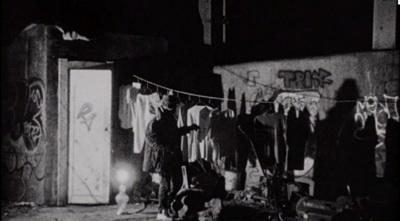 Even in this picture you can see that the person who lives here has cobbled together a home out of found materials and is actually hanging laundry outside to dry. It's surreal when you hear these supposedly homeless people talking about their balconies, their living rooms, and their various home renovations that they've made while they've been living there.
It's also strange because they also go to work like regular people. One man goes up every weekday to collect cans and bottles, while another rummages through garbage to find electronics and CD's and other things that he can pawn to make a few dollars. On the weekends, they rest and relax, so that they can go out and do it again next week.
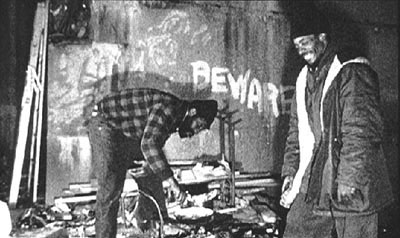 The movie is incredible, and I think if you're going to work on any kind of homeless project, this is a great place to start, because it gives incredible insight into the lives of the people who live in these conditions.
I plan on taking some cues from this movie as well. Tomorrow, I'd like to go through one of the first shots in the movie and study the structures that the people have built underground, making not of what materials and methods of connections are used to build these "houses". It's all found material, but what works for them? I think it would be an incredibly informative case study to look at, but I have to take it all with a grain of salt, as homeless people in Winnipeg face much different problems than homeless people in New York subways.
I plan on exploring how I can take these building typologies and adapt them to a much harsher climate, as well as to the outdoors. It's going to be challenging, but I think it will help define my project that much more and give me a solid base to make some good decisions.
1.20.2008
Site Selection
Shannon and I went to the site yesterday to try and find some appropriate sites in Point Douglas for our buildings to inhabit. We just about ended up freezing to death, but I think I might have actually found something that I can use. Plus, I got to test out my new camera, which was pretty sweet, I must say.

 This is pretty much it right here. This is just a little way down Higgins ave. The building at the back is Syrotech industries, and the one on the right is the National Lamp building. I'm not sure what the building on the left actually is, but I do know that it was the site of "Mural Fest 2k7".
One of the things that drew me to this site was the fact that it was already a point of communication. I've been getting into graffiti for a while now, and I've always been fascinated by it because of its ability to convey a message of territoriality with just a little bit of paint. It's a method of communication that's completely different from how we normally do things, and I find that really interesting. Another interesting thing on the site is on the right hand side behind the National Lamp building. It appears to be some kind of electronics graveyard, and we found the remnants of a bunch of old photocopiers and overhead projectors. This is a good source of junk that could be used for some kind of makeshift shelter, which is where the direction of my project seems to be heading.
 I ended up finding another potential site, as well, just a little further down Higgins. This is just behind the railroad, and just west of the railbridge, and has some similar qualities as the other site.

 This site is quite a bit smaller, but is still pretty interesting. It also has a lot of graffiti on it, but this site's graffiti is more obviously illegal. It also shows signs of previous use as a shelter, which the other site didn't have at all. This one is a little bit better hidden, which could be helpful in terms of building parasitic architecture, because it would be harder to notice. The only big problem here is protection from wind, as the left side is completely open. That, and there are constantly trains going by, but it might just be something that has to be dealt with.
I don't know which site I'm going to go with just yet, but I was thinking of using both sites and somehow networking them together. The second site has less of a chance to be networked because there aren't other buildings around to be networked with, while the other site can be somewhat networked using physical connections.
The next thing I have to decide is what I want to actually do with my site. I was thinking about going all around the site and finding sources of junk and building materials and building a catalog of pieces that could be used for building or communications. There are a lot of places to find bits of junk, and even the first site has wooden palettes to be used for building. It's something to think about, for sure, and it'll definitely take some more research to figure it all out.

 This is pretty much it right here. This is just a little way down Higgins ave. The building at the back is Syrotech industries, and the one on the right is the National Lamp building. I'm not sure what the building on the left actually is, but I do know that it was the site of "Mural Fest 2k7".
 One of the things that drew me to this site was the fact that it was already a point of communication. I've been getting into graffiti for a while now, and I've always been fascinated by it because of its ability to convey a message of territoriality with just a little bit of paint. It's a method of communication that's completely different from how we normally do things, and I find that really interesting.
 Another interesting thing on the site is on the right hand side behind the National Lamp building. It appears to be some kind of electronics graveyard, and we found the remnants of a bunch of old photocopiers and overhead projectors. This is a good source of junk that could be used for some kind of makeshift shelter, which is where the direction of my project seems to be heading.
 I ended up finding another potential site, as well, just a little further down Higgins. This is just behind the railroad, and just west of the railbridge, and has some similar qualities as the other site.
 This site is quite a bit smaller, but is still pretty interesting. It also has a lot of graffiti on it, but this site's graffiti is more obviously illegal. It also shows signs of previous use as a shelter, which the other site didn't have at all. This one is a little bit better hidden, which could be helpful in terms of building parasitic architecture, because it would be harder to notice. The only big problem here is protection from wind, as the left side is completely open. That, and there are constantly trains going by, but it might just be something that has to be dealt with.
I don't know which site I'm going to go with just yet, but I was thinking of using both sites and somehow networking them together. The second site has less of a chance to be networked because there aren't other buildings around to be networked with, while the other site can be somewhat networked using physical connections.
The next thing I have to decide is what I want to actually do with my site. I was thinking about going all around the site and finding sources of junk and building materials and building a catalog of pieces that could be used for building or communications. There are a lot of places to find bits of junk, and even the first site has wooden palettes to be used for building. It's something to think about, for sure, and it'll definitely take some more research to figure it all out.
Subscribe to:
Posts (Atom)
